Adsense

Showing posts with label Film Review. Show all posts

Monday, 3 April 2023

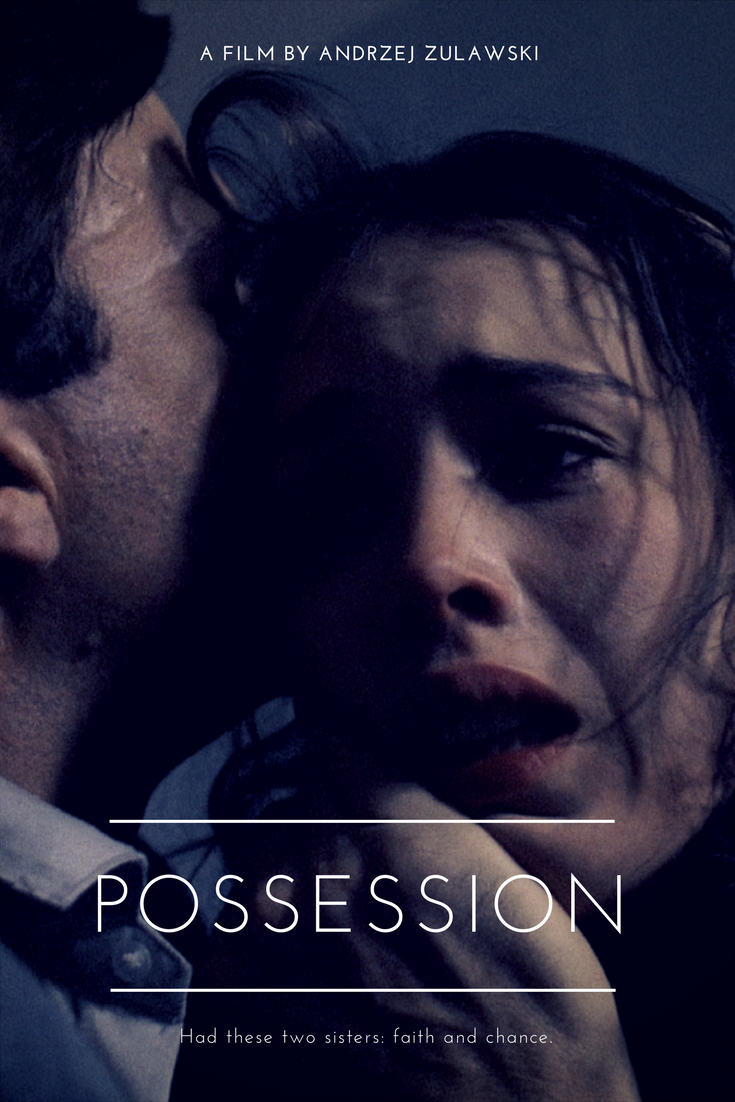
POSSESSION, or, DOES FAITH MURDER CHANCE IN A SUBWAY TUNNEL?

 POSSESSION, or, DOES FAITH MURDER CHANCE IN A SUBWAY TUNNEL?


(English, 1981)
Dir: Andrej Zulowski

Does 'Possession' have as many disparate elements as a Cronenberg creature? For a while, it certainly seems that way. Wending its way through a divorce drama psychological to creature horror to 'did the world just end?' horror, the film seems to be a collection of parts rather than a coherent whole. 

Set in West Berlin, 'Possession' begins with Mark (Sam Neill, from long before his appearances on 'Jurassic Park'), a cold war spy, returning from an assignment to his home where he finds his wife Anna (Isabelle Adjani shortly after her star-making turn in 'Adele H') seeking a separation. What begins as a story about how people in divorces can hurt each other quickly veers into a different territory as Anna exhibits some very odd behaviour. Mark continues his pursuit of Anna however and even confronts her lover. So far, it is a disturbing story, but still appears to follow the tropes of a divorce drama.

When a detective actually tracks down Anna to a secret apartment in an abandoned building, the movie becomes something else. Now coming thick and fast upon us are images of gore and squick, the director throwing the grossness at us with what appears to be unabashed glee.

Death and dismemberment follows in a cityscape bare of people, with desolate surroundings, always-messy interiors in nice, clean buildings and scrupulously clean floors in decrepit buildings. Anna's doppleganger Helena shows up. Heinrich (her former lover) too visits her secret apartment. Mark joins in on the murderous action. Various characters have sex with each other. Various characters hold each other's hand. Pink socks become important. 

And then things get worse.


By the end, when the credits roll, if you are left wondering what you just saw, that's possibly by design, but this is not the 'WTF' reaction exacted by many French film-makers, or even David 'WTF' Lynch. It is combined with a sense of relief that it is over. 

For 'Possession' is exhausting. It's like being battered with blunt instruments while piercing screams play in the background. 

In trying to understand why, I sought to separate the facets of the film. The camera-work is top-notch, the framing perfect for the effect sought to be created, for which one should credit Bruno Nuytten (who would go on to direct Camille Claudel). The acting is also fantastic, which I will come to later. 

But the script...that seems to be where the bulk of the blame would lie. The director also wrote the script for 'Possession', and the blame, if we are to call it such, is laid easily, for Zulowski clearly wrote the script in a disturbed state of mind, while going through his own divorce. Moreover, this is a French-German collaboration that, for reasons unknown, was made in English. And the disconnect shows. With only Sam Neill (A New Zealander) being at home in the language among the cast and possibly the crew, there is a sense of disconnect that contributes to the atmosphere of separation that pervades the film. The dialogue comes across as flowery to the point of being a joke. Incongruous language is delivered with theatrical flourish by actors lurching from side to side. The pacing is off, somehow, going along sometimes at a speed that does not allow for understanding, and the editing often renders the events on screen incomprehensible, making the central theme (the pain of separation, I speculate, for humans and countries) so obtuse as to be completely misconstrued by the end.

If all this sounds faintly ridiculous, it is, a little. But far more than that, it is disturbing, unsettling, often deeply so, and undoubtedly, for all its flaws, riveting.

The credit for holding the film together rests on the shoulders of Isabelle Adjani; shoulders which must have attained a strength far beyond their apparent delicateness over the course of her career. 


It is remarkable that she is able to portray vulnerability when Anna needs to be vulnerable, and diabolical when Anna needs to be diabolical, and do both equally convincingly. It is mind-blowing that she is able to radiate both feelings at the same time. And yet, this is Isabelle Adjani. 

Had the film cast Judy Davis (as was planned when Adjani's agency turned Zulowski down), or anyone else, it is certain 'Possession' would have been yet another obscurity of European cinema, a 'neither here-nor-there' film that could not decide whether it was horror or drama or even what kind of horror it was. But Adjani did eventually come around, and so we end up with a film that is still a 'neither here-nor-there' film, but now it is a 'neither here-nor-there' film that has one of the finest actors in the world carrying out a role of a lifetime. Bringing her intense physicality to the film, Adjani makes Anna into a maddening, haunting creature whose every movement speaks volumes and fixes the viewers attention to the screen. Completely unpredictable as the character is, it is the talent of the actress at never letting the viewer know what to expect next, but making what happens next perfectly believable, that allows 'Possession' to rise above the disjointed nature of its script.

Whether I would positively recommend 'Possession', I do not know. It is something of an artefact, a film made by a Polish director in Cold War Germany using a divorce and creature horror to make a statement about separation that ends up being too close to gibberish to really have an impact. But it also features some extraordinary flourishes from actors who gave a lot of themselves to their roles, and whose subsequent careers rightly speak to their talents.

So I suppose i would leave it as something that, if you do choose to watch - should be watched at the viewers own risk.


Monday, 13 July 2020

FILM REVIEW: GRAND HOTEL


GRAND HOTEL


“Grand Hotel…always the same. People come, people go. Nothing ever happens.”


Dr. Otternschlag, a disfigured World War 1 veteran says these, the opening lines of 1932’s Grand Hotel, and it is already evident he will soon be proved wrong. After all, no one’s going to make a film about nothing happening, and certainly not on the scale that MGM made Grand Hotel. For, in a time when studios zealously guarded their star power, only serving them out in moderate, digestible spoon-fuls of one or at best two from their A-list in a single film, MGM served up no less than five of their, and cinema history’s, most dazzling stars. 


The Barrymore brothers, John and Lionel. Wallace Beery. Greta Garbo. Joan Crawford. Each one could, and did, carry films on their own, and yet the studio found this story, adapted from a novel and already running as a musical on Broadway, worth investing their resources into, on this scale.


The star cast
(L-R) Lewis Stone, Lionel Barrymore, Wallace Beery, Joan Crawford,
Greta Garbo, John Barrymore, Jean Hersholt


That alone would make this film a significant piece of film history. Add to that its Best Picture win at the Oscars and the fact that it is this film that contains the line that pretty much became Garbo’s motto—I vant to be alone—and you have enough reasons to see the film for that historical value alone. Certainly, when I decided to watch it, I was not hoping for much more than an interesting historical artifact.


I was wrong.


The opening scene shows three of our protagonists using the payphones in the hotel lobby to speak to someone on the other end, and establishes their characters in a few deft lines of dialogue, a device that is now so standard in films that we don’t even realise it’s being used. 


The Baron (played by John Barrymore) is genteel, refined, and deeply in debt.


Otto Kringlein (played by Lionel Barrymore) is an accountant who has learned of his terminal illness and plans to spend his last days enjoying the grandeur of the hotel.


Preysing (played by Wallace Beery) is a pompous capitalist with an inflated pride and sense of moral superiority, who nonetheless is actually heading a failing company (and incidentally, Kringlein works at that same factory). 


A little later, we encounter the women—


Grusinskaya (played by Greta Garbo), a Russian dancer who seems to have fled / been exiled for her Tsarist sympathies from the Soviet Union. She is caught in a vicious circle—dwindling audiences for her shows have left her depressed, her depression leads to her heart not being in her dancing, with her heart not in it, her performances are not well-received, and the audiences dwindle. 


and Flaemmchen (played by Joan Crawford), a freelance stenographer with no money, an early example of the sexy-secretary archetype, no doubt, who is not unwilling to use her considerable charms to make some, though she is also starved for affection and friendship.


Joan Crawford and Wallace Beery


The ensemble characters follow their individual arcs, intersecting and cutting across each other in the opulent lobbies, rooms and corridors of the Grand Hotel


The Baron tries to balance his innate good nature with the crimes he needs to commit to survive; Kringlein finds friendship in unexpected places; Preysing’s hypocrisy leads his moral façade to unravel quickly; Grusinskaya plumbs the depths of depression as the people surrounding her exploit her for their own ends; and Flaemchhen finds that walking the tightrope between worldly ambition and personal decency is far too difficult to endure.


The scenes blend seamlessly into one another and the pace is quick—one does not, for a moment, feel too far removed from the main action—this is no shuffling period piece, it’s the Grand Hotel, and for a place where nothing ever happens, there sure is a lot going on. The film uses a large cast of extras beautifully, creating the impression of a bustling, living place rather than a bland set-piece, which the Hotel could so easily have been. There are lives and stories going on in the background, behind every closed door and every counter, in the tables and the revolving doors.


Lionel Barrymore and Joan Crawford


The camerawork is exquisite, the black-and-white often more bright and alive than many a celebrated 70’s-80’s work. And MGM’s stars deliver, each doing what they need to ensure they are not lost in the ensemble.


Beery is superb in his Harvey Weinstein-esque turn, menacing and despicable in equal measure. 


Lionel Barrymore is the heart of the story, a ‘loser’ who effortlessly draws forth our empathy for the dignity with which he faces his fate, something that it takes considerable acting skill to pull off.


John Barrymore is regal, the perfect fallen aristocrat, charming and dignified, threading the needle in the conflict between his innate nobility and his circumstantial villainy.


John Barrymore and Greta Garbo


Garbo plays the dancer with exaggerated mannerisms and dialogue delivery—whether a result of her days in silent films leading her to be overdramatic in general, or as a deliberate nod to how the Tsarist Russians actually were, I could not say. Her power to enchant is undeniable however, and when she says that line, that accented delivery of “I just want to be alone,” there is a moment when we see the anguish in her eyes which, knowing what we know now about her later shutting out of Hollywood and reclusiveness, makes it especially poignant. 


And yet, Joan Crawford outshines the divine Garbo (and how many people could claim to have ever done that?) as she smoulders with sex appeal and uses her expressive eyes to great effect. Bette Davis, in one of her classic put-downs, is said to have said of Joan Crawford that she had slept with every male co-star at MGM. Well, that may not be true, but if any of her male co-stars at MGM did not want to sleep with her, they probably weren’t straight. To audiences who saw her on the big screen back then—gentlemen, you may be long-dead, but you had a glimpse of a goddess in a way that we never will, and we will forever envy you for it.


Joan Crawford and John Barrymore


Grand Hotel draws to its conclusion in under two hours, though the time seems to have flashed past us much faster than that. And as old guests check out, and new ones check in, the old doctor repeats himself.


“Grand Hotel…always the same. People come, people go. Nothing ever happens.”


And this time, we wonder whether it is really a comedic line at all. For Grand Hotel is a story that could be made today and you would have to change very little, nothing but the cosmetic details. The issues and themes it touches upon—this, this relic of a film from ninety years ago—they don’t feel aged at all. Grand Hotel is always the same because we are the same, and the world is, and even these intense stories, these great dramatic moments that are so important in that moment, mean very little, really, to others. 


For people come and people go, but the fundamentals of human nature remain the same, and Grand Hotel, well, Grand Hotel was never a film about a hotel in 1932, was it? 


It was about life.


What do you do in the Grand Hotel? Eat. Sleep. Loaf around. Flirt a little. Dance a little. A hundred doors leading to one hall, and no one knows anything about the person next to them. And when you leave, someone occupies your room, lies in your bed, and that's the end.


Tuesday, 31 March 2020

Emma, and Emma., or, The Inevitable Pitfalls of Modernity

EMMA, AND EMMA.

OR

THE INEVITABLE PITFALLS OF MODERNITY


(This review assumes a working-level of familiarity with the plot on the part of the reader. There are no spoilers, but some parts might be difficult to appreciate to those that haven’t at least read the Wikipedia page or my review of the book.)


I love Jane Austen’s Emma. I read the book for the first time a very long time ago, and that, and every subsequent re-read, of which there have been more than one, have brought a good deal of joy. The book is witty, exquisitely comic and at the same time very human and touching. Austen lights a very affectionate light on the foibles of the landed gentry, while offering enough insight into their faults, and peppers it with her trademark genius of dialogue and social commentary. It is also different—perhaps unique—from the rest of her output in that the protagonist is not a plucky, impecunious woman in search of a wealthy husband, but an independently wealthy, self-assured young woman who is more interested in arranging a match for her impecunious friends.

But my views on the book have been elaborated in my review of it. This is not about that so much as it is about the film adaptation of it. Despite, or perhaps because of, my love for the book, I had not seen any of the film or series adaptations of Emma other than Clueless (1994; starring Alicia Silverstone and directed by Amy Heckerling), which I did not know at the time was based on the book. 


Now Clueless is a masterpiece of its genre, beautifully merging Austen’s 1815 wit into 1995 California and the high-school social scene, and it does a fantastic job of capturing the social differentiation of the book, without losing the essence of its humour. Yet, as a ‘modern-day retelling’, it gets a lot of leeway on what elements it takes and which ones it ignores; the beauty is in the attempt itself, and execution must be judged more against the contemporary teen dramas it was released alongside than the 1800’s novel it was inspired by.

Poster - Emma. (2020)
That luxury is not available to the two major film adaptations that are more directly drawn from the book. One is the 1996 film, starring Gwyneth Paltrow in the title role and directed by Douglas McGrath. The other was released in February of this year, staring Anya Taylor-Joy, and is directed by Autumn De Wilde

The 2020 version is absolutely gorgeous in its visuals. The photography, the scene composition, the sets and costumes, are all stunning. However, the director’s vision, and Eleanor Catton’s screenplay, seem determined to explore only the comic aspects of Austen’s work, at the expense of everything else. Every actor plays their character like a one-note trombone; and that note seems to be the most ridiculous one that could be found. Unfortunately, this makes virtually everyone some sort of clown, and as the audience, we are left wondering why any of these people would even find anything to love about each other, let alone getting us to like them. It becomes, in the end, a funny but un-engaging film, losing any depth the text might have had by virtue of never attempting to do more than dip its toes into it.

Moreover, in a film like this, the anchor needs to be the titular role, and this is a mantle that Anya Taylor-Joy is unable, or not allowed to, fully embrace. It is true that Emma, as Austen wrote her, was not made to pander to audience expectations; she is spoilt and vain, but she is also intelligent and kind-hearted. Emma’s faults stem from simply having had her own way for too long under an indulgent father and considerable wealth, but she is also a capable, if lazy, artist and musician, genuinely affectionate toward those she sees as less fortunate, and has managed her father’s estate since she was twelve. But in the drive to emphasise only the most obvious aspects of each character, such subtleties are lost; what we get through Ms Taylor-Joy, and through the film, is Emma seen strictly through modern eyes; bright to the point of harshness, grand in scale so it can show the protagonists to be small, stacked with unsubtle clues about how woke the film-makers are, and how patriarchal the structure was at the time the film is set in.


Which brings us to the 1996 adaptation. It was an era of considerable interest in Austen’s works—both television and film were brimming with adaptations—there was a Sense and Sensibility film starring Emma Thompson and a pre-Titanic Kate Winslet that came out around the same time, the Pride and Prejudice TV series had introduced Colin Firth to the world, an Emma  TV series in the UK, and if one extends our comparison to period dramas in general, there were so many more—The Age of Innocence, The Last of the Mohicans, Braveheart and Little Women (yes, Emma isn’t the only film of that era to get a 25-year-later-reload). This would go some way toward explaining why it does not stand out particularly in one’s memory—there are only so many wigs and petticoats an audience will stand to remember.

But McGrath’s adaptation is actually remarkably faithful to the book, sequencing and portraying far more accurately than its 2020 counterpart. Far from shining a harsh, almost dismissively judgemental light on the characters, as De Wilde does, McGrath’s version takes a gentler approach, and uses soft-focus liberally to build a world of pastels and flowers. Not a scene appears to be out of place or even indulgent. But there is a sense of embellishment; Emma and Mr Knightley are both shown, perhaps, to be nicer than they are, and Mr Woodhouse’s faults, which Austen makes no bones about driving home, are papered over. This does bring a sense of blandness, sometimes, despite the earnest attempts of the cast.

None more earnest than Collette as Harriet
That cast is, it must be said, impressive. There’s Jeremy Northam (Gosford Park, The Tudors, The Crown) and Alan Cummings (The Good WifeSpy Kids) as the dignified Mr Knightley and the vain Mr Elton respectively. There’s Toni Collette (The Sixth Sense, Muriel’s Wedding, Little Miss Sunshine, Knives Out) as silly little Harriet Smith, the subject of Emma’s social experiments. There’s Ewan McGregor, though he’d like to pretend he wasn’t because damn, that wig is inexcusable. 

And then there’s Gwyneth Paltrow. For all her considerable faults in terms of being a vendor of pseudo-scientific claptrap, the undeniable fact remains that Ms Paltrow can be irresistibly charming when she wants to be, and she brings that charm to bear upon this film in full measure. Often appearing to channel Audrey Hepburn in her acting style (all right, aping Audrey Hepburn, but she comes close to pulling it off. I wouldn’t suggest anyone else try.), Ms Paltrow plays Emma as a shallow-but-intrinsically-loving daughter and friend, and there are times we see glimpses of true acting range. Emma’s emotions are an open book, beautifully conveyed on the canvas of Ms Paltrow’s face, and though at times her beauty threatens to overwhelm the story, that is not a fault one should place at her feet.


All said and done, it is much easier to recommend the 1996 version over the 2020 version, if for nothing else than for the fact that it represents Jane Austen’s text far more accurately; if you have read the book and want to refresh the story in your mind, or find you can’t read the book at all, that’s the version to go with.

But my honest suggestion would be to take the effort to read the text—and then watch Clueless for the sheer fun of it.

Saturday, 14 March 2020

Film Review: Judy, over the rainbow


FILM REVIEW : JUDY

OR

YOU CAN'T WRITE ABOUT THE RAINBOW AND LEAVE OUT FIVE OF ITS COLOURS!


If Judy had been about a fictional film-star-singer, it might have been a good film. Vacuous at its core, maybe, and not particularly memorable, but a good film.

It starts off in 1939, with a then-16-year-old Judy auditioning for The Wizard of Oz. Studio boss Louis Mayer points out, in excruciating detail, her limitations when it comes to attractiveness, and asks if she has it in her to overcome them to play one of literature’s most iconic roles.

It cuts forward to 1969, where a near-bankrupt Judy, debilitated by drink and drugs, presumably brought on by the inferiority complex engendered by the early studio years, is forced to accept a 5-week residency in London to perform a series of concerts if she wants any hope of making enough money to live on and keep her children.

Most of the film is then shown in that 1969 era, as Judy struggles to deal with addiction and co-dependency, with a few flashbacks to the shooting of The Wizard of Oz. As such, it becomes a chronicle of rather pathetic failure, as the fading once-beloved film star runs down an abyss driven by bad decisions, drink and drugs. The flashbacks try to show her as being constantly put upon by the studio and seems to hold them—and at a personal level, Mayer—responsible for Judy’s present condition while at the same time implying that she peaked as the rosy-cheeked Dorothy. 

A good enough film, of the “suffering-porn” variety. Take your three stars and be forgotten, fated to the Netflix recommendation queue for those who like ‘films with strong female leads’.

But that’s not what Judy is, is it?

It’s not about a fictional character. It’s about Judy. It’s about Judy-fuckin’-Garland.


Judy-fuckin’-Garland was born Frances Gumm in a family of vaudeville entertainers just as vaudeville was going out of fashion. She transitioned to film at 13 following a screen test, and was signed with MGM on a long-term contract. That was not remotely ordinary; thirteen is too old for a ‘child’ star, and too young for a regular actress. And yes, while she was certainly pretty, this was at a time when MGM’s other contract stars were Hedy Lamarr, Lana Turner and Greta Garbo—women whose beauty was of the spectacular, unforgettable kind. The kind that would outshine anyone not named Elizabeth Taylor or Ava Gardner (MGM’s next generation of signings).

L-R, Hedy Lamar, Lana Turner, Greta Garbo, Ava Gardner, Elizabeth Taylor

But Judy Garland was signed anyway.

Judy, the film, touches upon one reason for it in its opening scene—Mayer points out she has a great voice. Well, that vastly undersells it. Judy Garland had once-in-a-generation vocals. In her teens, she could belt a full-throated melody with admirable control, and she did it in a voice that was bigListening to Judy Garland is to be mesmerized by possibilities; there seems to be a constant, imminent sense of danger about it; like sitting in a racing Ferrari. Even at 40 km/h, the car’s engine hums with the prospect of topping 250 km/h without breaking a sweat, and that’s what Garland’s voice is like—she doesn’t sing epic songs; songs become epic because she sings them. 


What the film fails to mention is that she could dance, as she did, with Fred Astaire and, more often, Gene Kelley, and she could act the full range from frothy comedies to overpowering drama. 

And with all that, I’m sure, was a healthy dose of ambition. Because with all the 18-hour workdays and drugs that had become a part of studio life, we need to remember that this relatively-ordinary-looking girl, who worked in an era alongside the most beautiful women in the world, more than held her own. 

For that brings us to another misconception that Judy would foist upon us—that she was the ­girl from The Wizard of Oz and that pretty much defined her career. In reality, while that may be the film one most closely identifies with her now, after it has been shown to most of white America in their formative years, remember that this was far from the case back then. In fact, The Wizard of Oz lost money for MGM, only recouping it on re-release in 1949 and then, of course, going into super-profits when it became a TV staple (CBS paid MGM $225,000 for every time they broadcast it—in the fifties). Judy Garland made her reputation basis a string of hits as a young woman throughout the forties, parlaying her voice and dancing and acting to become one of Hollywood’s most reliable box-office draws. She had become difficult to work with—drugs and depression took their toll, and multiple suicide attempts preceded the last one—and that meant delayed productions and re-shoots, but she was still MGM’s biggest star. 


We don’t see much of that in Judy. We don’t see what made her an icon, we are just told it, through expository dialogue that often falls flat, and yes, that means the film manages, despite being a visual medium, to fall into the trap of telling, and not showing. In trying to put forth a story of a ‘fall from the heights’, Judy emphatically fails to capture just how dizzyingly high those heights were, and the grit and hard work and talent that took its protagonist there. 

That’s where Rene Zellweger’s singing voice doesn’t help either.

Let me be fair—Zellweger does a brilliant job of replicating Garland’s expressions and mannerisms, not only is the resemblance strong, but the portrayal seems to be spot-on…until she sings. 

For some reason (okay, I kind of know the reason, but that’s a whole different discussion), Hollywood does not let its actresses get playbacks, and as a result, we have Rene Zellweger, a non-singer, provide the soundtrack for one of the top singing stars of the industry. Imagine a Lata Mangeshkar biopic, starring Kangana Ranaut, where she has to sing in her own voice. It’s not that Zellweger can’t hold a note; she can sing, but she doesn’t sound like someone who once had a voice that comfortably enthralled Carnegie Hall, that seemed to glow with warmth and bristle with pain, even before those things were really a part of her life. 

But if nothing else, Judy will hopefully revive interest in the character it purports to portray, and if in doing so, it drives some of its viewers to check out A Star is Born (1954), Ziegfield Girl, Meet Me in St. Louis, Easter Parade, Summer Stock and so on, it will have accomplished a great deal of good. And I dare say they would get a much better idea of the character from seeing her perform.

And yeah, if you haven't, go watch The Wizard of Oz. If you don't cry during 'Somewhere Over the Rainbow' on your second viewing (because of course there will be a second viewing), you may be dead already.


Friday, 24 January 2020

Film Review: What happened in 1917?

WHAT HAPPENED IN 1917?


What are the stories we choose to tell?

Every one of us grew up surrounded by stories. Some, we were told were stories. Others, we thought we knew to be the truth, until time revealed they, too, were stories of a kind. Still others were stories we told ourselves, one way or another. And sometimes these stories were embellished, and sometimes they were honest, and sometimes they were important to the world, and sometimes they were important to us, more than anyone else, but the ones we remember best are the ones that were our stories, and those were the once we wanted to tell.

In 1917, Sam Mendes tells a story, but…it’s not quite the story we might have expected.

After all, the ‘War Film’ is not new; from All Quiet on the Western Front (1930), through The Best Years of Our Lives (1946) to Patton (1970), Coming Home (1978), Apocalypse Now (1979), Saving Private Ryan (1998)and last year’s Dunkirk, we have seen a number of films that dealt with war and its aftermath. Some of them follow a person, some an event, some take a more macro-level view of the ‘theatre’ of war, and the best ones have always shown up the futility of it, even in the midst of acts of great personal heroism. Hell, even Wonder Woman, that glorious, campy, charming World War I film, makes it a point to show Diana’s artless optimism wither away in the face of the realities she is facing.


But 1917, in a sense, is not about that. Or not as much as you think it would be.

The film begins and ends with a near-identical shot of a soldier relaxing against a tree. The story is what happens in-between, a saga that begins in a bunker in a trench and ends just outside a hospital-tent. It’s a heart-stopping, heart-rending, breath-taking, awe-inspiring saga of a mission to get a message across and through enemy lines to call off an attack, and through the use of a simulated single-shot, we are thrust into the story as though it were happening to us. We see the desperation of the men in the trenches, the rotting bodies and the pecking crows, the gnawing rats and the clouds of dust, the murky, blood-stained water, the senseless violence and gruesome deaths, the heavy, brutal reality checks, and the moments of tenderness that seem to redeem us as much as the characters.

Through long stretches of silence punctuated by loud noise, pitch darkness and vibrant light, silhouettes and close-ups, frantic chases and a memorable, melancholy moment of rest, 1917  tells a story that is utterly riveting; an experience that only Indian theatre-owners and their insistence on an ‘Intermission’ to sell overpriced popcorn can harm, though even so, not ruin.


George MacKay and Dean Charles Chapman are the lead actors in this drama, tasked with delivering a message to a regiment deeper in German-held France that is on the verge of walking into a trap. One of the soldiers in that regiment is the elder brother of Chapman’s Lieutenant Blake, giving him the personal interest in the mission’s success that the higher-ups seem to think is essential. He and his friend, an initially-resentful Schofield (MacKay), set off, through the trenches on their front, full of weary, irritable soldiers, past the men holding the frontline, past No Man’s Land, into the German trench, and beyond. 

Mendes paints scenes—or rather, given the whole film is simulated as one scene, let us call them moments—that stick in the viewer’s consciousness. 

There is the moment we realise that the General did not even know that the Colonel he referred the men to, had been dead for two days; when a Lieutenant administers them their final rites as they prepare to climb out of their trench; when Schofield’s hand goes into a dead man’s gaping, open, chest wound. Many, many moments when all hope is lost, moments when we see in the background a futility to their efforts that does not render them any less noble, moments of incredible beauty, as a village is lit up with blazing lights that are almost festive in their deadly, destructive dazzle.


And the climax, the rousing, distressing, stand-up-in-your-seat eye-popping climax…followed by the inevitable low of the realisation of how temporary victories are in a war such as this, of knowing that the war would not end till another year had passed, only to be followed by another.

1917 is all this, an achievement of technical brilliance, a thing of awesome beauty that leaves a lasting impression.

But it is, still, a story. The sort of story; perhaps a specific one, that Sam Mendes’ grandfather may have told him. A story of hope, with a hero and his journey, an Odysseus-like voyage through terror and treachery. In an age where memories of that time fade; when we think of that horrible war as an afterthought, when those who fought in it are long gone, it is an important story to tell, for it speaks to hope, and bravery, without glossing over the trauma that war engenders.

What it is not, is a commentary. As war films go, there have been better; as commentaries go, there have been better; but that—that is judging a fish on its ability to fly.

1917 is a story a man chose to tell, and he told it marvellously well. 

We should not ask for more than that.