Adsense

Showing posts with label Films. Show all posts

Monday, 3 April 2023

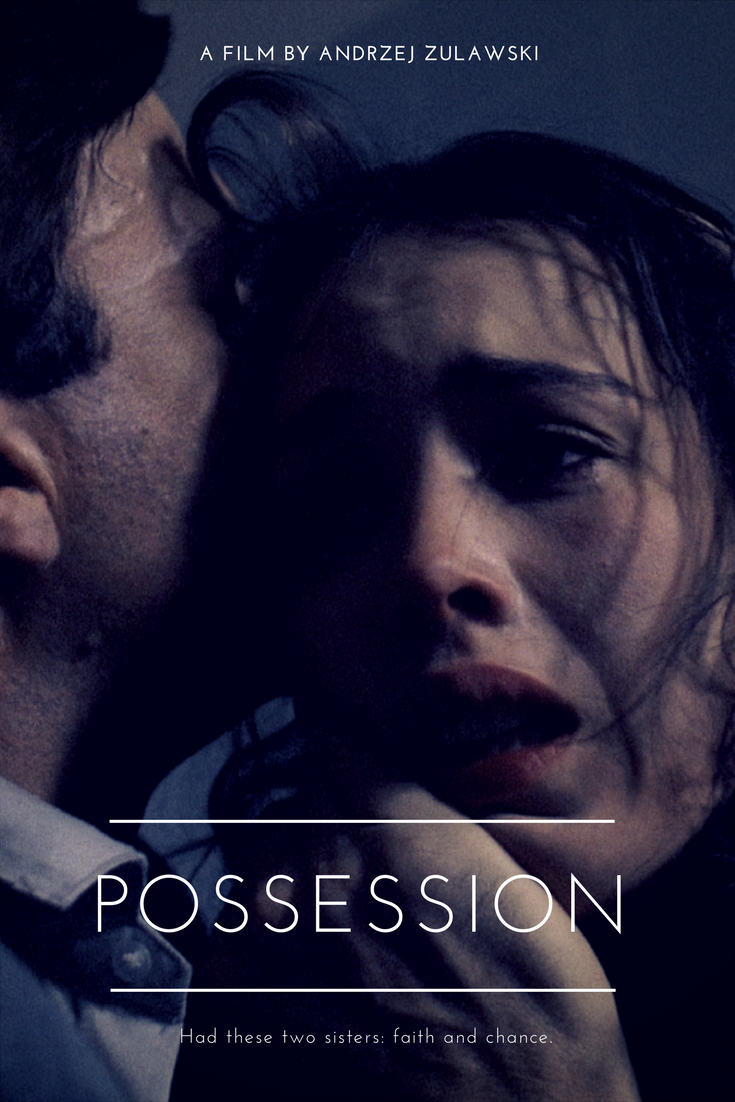
POSSESSION, or, DOES FAITH MURDER CHANCE IN A SUBWAY TUNNEL?

 POSSESSION, or, DOES FAITH MURDER CHANCE IN A SUBWAY TUNNEL?


(English, 1981)
Dir: Andrej Zulowski

Does 'Possession' have as many disparate elements as a Cronenberg creature? For a while, it certainly seems that way. Wending its way through a divorce drama psychological to creature horror to 'did the world just end?' horror, the film seems to be a collection of parts rather than a coherent whole. 

Set in West Berlin, 'Possession' begins with Mark (Sam Neill, from long before his appearances on 'Jurassic Park'), a cold war spy, returning from an assignment to his home where he finds his wife Anna (Isabelle Adjani shortly after her star-making turn in 'Adele H') seeking a separation. What begins as a story about how people in divorces can hurt each other quickly veers into a different territory as Anna exhibits some very odd behaviour. Mark continues his pursuit of Anna however and even confronts her lover. So far, it is a disturbing story, but still appears to follow the tropes of a divorce drama.

When a detective actually tracks down Anna to a secret apartment in an abandoned building, the movie becomes something else. Now coming thick and fast upon us are images of gore and squick, the director throwing the grossness at us with what appears to be unabashed glee.

Death and dismemberment follows in a cityscape bare of people, with desolate surroundings, always-messy interiors in nice, clean buildings and scrupulously clean floors in decrepit buildings. Anna's doppleganger Helena shows up. Heinrich (her former lover) too visits her secret apartment. Mark joins in on the murderous action. Various characters have sex with each other. Various characters hold each other's hand. Pink socks become important. 

And then things get worse.


By the end, when the credits roll, if you are left wondering what you just saw, that's possibly by design, but this is not the 'WTF' reaction exacted by many French film-makers, or even David 'WTF' Lynch. It is combined with a sense of relief that it is over. 

For 'Possession' is exhausting. It's like being battered with blunt instruments while piercing screams play in the background. 

In trying to understand why, I sought to separate the facets of the film. The camera-work is top-notch, the framing perfect for the effect sought to be created, for which one should credit Bruno Nuytten (who would go on to direct Camille Claudel). The acting is also fantastic, which I will come to later. 

But the script...that seems to be where the bulk of the blame would lie. The director also wrote the script for 'Possession', and the blame, if we are to call it such, is laid easily, for Zulowski clearly wrote the script in a disturbed state of mind, while going through his own divorce. Moreover, this is a French-German collaboration that, for reasons unknown, was made in English. And the disconnect shows. With only Sam Neill (A New Zealander) being at home in the language among the cast and possibly the crew, there is a sense of disconnect that contributes to the atmosphere of separation that pervades the film. The dialogue comes across as flowery to the point of being a joke. Incongruous language is delivered with theatrical flourish by actors lurching from side to side. The pacing is off, somehow, going along sometimes at a speed that does not allow for understanding, and the editing often renders the events on screen incomprehensible, making the central theme (the pain of separation, I speculate, for humans and countries) so obtuse as to be completely misconstrued by the end.

If all this sounds faintly ridiculous, it is, a little. But far more than that, it is disturbing, unsettling, often deeply so, and undoubtedly, for all its flaws, riveting.

The credit for holding the film together rests on the shoulders of Isabelle Adjani; shoulders which must have attained a strength far beyond their apparent delicateness over the course of her career. 


It is remarkable that she is able to portray vulnerability when Anna needs to be vulnerable, and diabolical when Anna needs to be diabolical, and do both equally convincingly. It is mind-blowing that she is able to radiate both feelings at the same time. And yet, this is Isabelle Adjani. 

Had the film cast Judy Davis (as was planned when Adjani's agency turned Zulowski down), or anyone else, it is certain 'Possession' would have been yet another obscurity of European cinema, a 'neither here-nor-there' film that could not decide whether it was horror or drama or even what kind of horror it was. But Adjani did eventually come around, and so we end up with a film that is still a 'neither here-nor-there' film, but now it is a 'neither here-nor-there' film that has one of the finest actors in the world carrying out a role of a lifetime. Bringing her intense physicality to the film, Adjani makes Anna into a maddening, haunting creature whose every movement speaks volumes and fixes the viewers attention to the screen. Completely unpredictable as the character is, it is the talent of the actress at never letting the viewer know what to expect next, but making what happens next perfectly believable, that allows 'Possession' to rise above the disjointed nature of its script.

Whether I would positively recommend 'Possession', I do not know. It is something of an artefact, a film made by a Polish director in Cold War Germany using a divorce and creature horror to make a statement about separation that ends up being too close to gibberish to really have an impact. But it also features some extraordinary flourishes from actors who gave a lot of themselves to their roles, and whose subsequent careers rightly speak to their talents.

So I suppose i would leave it as something that, if you do choose to watch - should be watched at the viewers own risk.


Tuesday, 31 March 2020

Emma, and Emma., or, The Inevitable Pitfalls of Modernity

EMMA, AND EMMA.

OR

THE INEVITABLE PITFALLS OF MODERNITY


(This review assumes a working-level of familiarity with the plot on the part of the reader. There are no spoilers, but some parts might be difficult to appreciate to those that haven’t at least read the Wikipedia page or my review of the book.)


I love Jane Austen’s Emma. I read the book for the first time a very long time ago, and that, and every subsequent re-read, of which there have been more than one, have brought a good deal of joy. The book is witty, exquisitely comic and at the same time very human and touching. Austen lights a very affectionate light on the foibles of the landed gentry, while offering enough insight into their faults, and peppers it with her trademark genius of dialogue and social commentary. It is also different—perhaps unique—from the rest of her output in that the protagonist is not a plucky, impecunious woman in search of a wealthy husband, but an independently wealthy, self-assured young woman who is more interested in arranging a match for her impecunious friends.

But my views on the book have been elaborated in my review of it. This is not about that so much as it is about the film adaptation of it. Despite, or perhaps because of, my love for the book, I had not seen any of the film or series adaptations of Emma other than Clueless (1994; starring Alicia Silverstone and directed by Amy Heckerling), which I did not know at the time was based on the book. 


Now Clueless is a masterpiece of its genre, beautifully merging Austen’s 1815 wit into 1995 California and the high-school social scene, and it does a fantastic job of capturing the social differentiation of the book, without losing the essence of its humour. Yet, as a ‘modern-day retelling’, it gets a lot of leeway on what elements it takes and which ones it ignores; the beauty is in the attempt itself, and execution must be judged more against the contemporary teen dramas it was released alongside than the 1800’s novel it was inspired by.

Poster - Emma. (2020)
That luxury is not available to the two major film adaptations that are more directly drawn from the book. One is the 1996 film, starring Gwyneth Paltrow in the title role and directed by Douglas McGrath. The other was released in February of this year, staring Anya Taylor-Joy, and is directed by Autumn De Wilde

The 2020 version is absolutely gorgeous in its visuals. The photography, the scene composition, the sets and costumes, are all stunning. However, the director’s vision, and Eleanor Catton’s screenplay, seem determined to explore only the comic aspects of Austen’s work, at the expense of everything else. Every actor plays their character like a one-note trombone; and that note seems to be the most ridiculous one that could be found. Unfortunately, this makes virtually everyone some sort of clown, and as the audience, we are left wondering why any of these people would even find anything to love about each other, let alone getting us to like them. It becomes, in the end, a funny but un-engaging film, losing any depth the text might have had by virtue of never attempting to do more than dip its toes into it.

Moreover, in a film like this, the anchor needs to be the titular role, and this is a mantle that Anya Taylor-Joy is unable, or not allowed to, fully embrace. It is true that Emma, as Austen wrote her, was not made to pander to audience expectations; she is spoilt and vain, but she is also intelligent and kind-hearted. Emma’s faults stem from simply having had her own way for too long under an indulgent father and considerable wealth, but she is also a capable, if lazy, artist and musician, genuinely affectionate toward those she sees as less fortunate, and has managed her father’s estate since she was twelve. But in the drive to emphasise only the most obvious aspects of each character, such subtleties are lost; what we get through Ms Taylor-Joy, and through the film, is Emma seen strictly through modern eyes; bright to the point of harshness, grand in scale so it can show the protagonists to be small, stacked with unsubtle clues about how woke the film-makers are, and how patriarchal the structure was at the time the film is set in.


Which brings us to the 1996 adaptation. It was an era of considerable interest in Austen’s works—both television and film were brimming with adaptations—there was a Sense and Sensibility film starring Emma Thompson and a pre-Titanic Kate Winslet that came out around the same time, the Pride and Prejudice TV series had introduced Colin Firth to the world, an Emma  TV series in the UK, and if one extends our comparison to period dramas in general, there were so many more—The Age of Innocence, The Last of the Mohicans, Braveheart and Little Women (yes, Emma isn’t the only film of that era to get a 25-year-later-reload). This would go some way toward explaining why it does not stand out particularly in one’s memory—there are only so many wigs and petticoats an audience will stand to remember.

But McGrath’s adaptation is actually remarkably faithful to the book, sequencing and portraying far more accurately than its 2020 counterpart. Far from shining a harsh, almost dismissively judgemental light on the characters, as De Wilde does, McGrath’s version takes a gentler approach, and uses soft-focus liberally to build a world of pastels and flowers. Not a scene appears to be out of place or even indulgent. But there is a sense of embellishment; Emma and Mr Knightley are both shown, perhaps, to be nicer than they are, and Mr Woodhouse’s faults, which Austen makes no bones about driving home, are papered over. This does bring a sense of blandness, sometimes, despite the earnest attempts of the cast.

None more earnest than Collette as Harriet
That cast is, it must be said, impressive. There’s Jeremy Northam (Gosford Park, The Tudors, The Crown) and Alan Cummings (The Good WifeSpy Kids) as the dignified Mr Knightley and the vain Mr Elton respectively. There’s Toni Collette (The Sixth Sense, Muriel’s Wedding, Little Miss Sunshine, Knives Out) as silly little Harriet Smith, the subject of Emma’s social experiments. There’s Ewan McGregor, though he’d like to pretend he wasn’t because damn, that wig is inexcusable. 

And then there’s Gwyneth Paltrow. For all her considerable faults in terms of being a vendor of pseudo-scientific claptrap, the undeniable fact remains that Ms Paltrow can be irresistibly charming when she wants to be, and she brings that charm to bear upon this film in full measure. Often appearing to channel Audrey Hepburn in her acting style (all right, aping Audrey Hepburn, but she comes close to pulling it off. I wouldn’t suggest anyone else try.), Ms Paltrow plays Emma as a shallow-but-intrinsically-loving daughter and friend, and there are times we see glimpses of true acting range. Emma’s emotions are an open book, beautifully conveyed on the canvas of Ms Paltrow’s face, and though at times her beauty threatens to overwhelm the story, that is not a fault one should place at her feet.


All said and done, it is much easier to recommend the 1996 version over the 2020 version, if for nothing else than for the fact that it represents Jane Austen’s text far more accurately; if you have read the book and want to refresh the story in your mind, or find you can’t read the book at all, that’s the version to go with.

But my honest suggestion would be to take the effort to read the text—and then watch Clueless for the sheer fun of it.

Saturday, 14 March 2020

Film Review: Judy, over the rainbow


FILM REVIEW : JUDY

OR

YOU CAN'T WRITE ABOUT THE RAINBOW AND LEAVE OUT FIVE OF ITS COLOURS!


If Judy had been about a fictional film-star-singer, it might have been a good film. Vacuous at its core, maybe, and not particularly memorable, but a good film.

It starts off in 1939, with a then-16-year-old Judy auditioning for The Wizard of Oz. Studio boss Louis Mayer points out, in excruciating detail, her limitations when it comes to attractiveness, and asks if she has it in her to overcome them to play one of literature’s most iconic roles.

It cuts forward to 1969, where a near-bankrupt Judy, debilitated by drink and drugs, presumably brought on by the inferiority complex engendered by the early studio years, is forced to accept a 5-week residency in London to perform a series of concerts if she wants any hope of making enough money to live on and keep her children.

Most of the film is then shown in that 1969 era, as Judy struggles to deal with addiction and co-dependency, with a few flashbacks to the shooting of The Wizard of Oz. As such, it becomes a chronicle of rather pathetic failure, as the fading once-beloved film star runs down an abyss driven by bad decisions, drink and drugs. The flashbacks try to show her as being constantly put upon by the studio and seems to hold them—and at a personal level, Mayer—responsible for Judy’s present condition while at the same time implying that she peaked as the rosy-cheeked Dorothy. 

A good enough film, of the “suffering-porn” variety. Take your three stars and be forgotten, fated to the Netflix recommendation queue for those who like ‘films with strong female leads’.

But that’s not what Judy is, is it?

It’s not about a fictional character. It’s about Judy. It’s about Judy-fuckin’-Garland.


Judy-fuckin’-Garland was born Frances Gumm in a family of vaudeville entertainers just as vaudeville was going out of fashion. She transitioned to film at 13 following a screen test, and was signed with MGM on a long-term contract. That was not remotely ordinary; thirteen is too old for a ‘child’ star, and too young for a regular actress. And yes, while she was certainly pretty, this was at a time when MGM’s other contract stars were Hedy Lamarr, Lana Turner and Greta Garbo—women whose beauty was of the spectacular, unforgettable kind. The kind that would outshine anyone not named Elizabeth Taylor or Ava Gardner (MGM’s next generation of signings).

L-R, Hedy Lamar, Lana Turner, Greta Garbo, Ava Gardner, Elizabeth Taylor

But Judy Garland was signed anyway.

Judy, the film, touches upon one reason for it in its opening scene—Mayer points out she has a great voice. Well, that vastly undersells it. Judy Garland had once-in-a-generation vocals. In her teens, she could belt a full-throated melody with admirable control, and she did it in a voice that was bigListening to Judy Garland is to be mesmerized by possibilities; there seems to be a constant, imminent sense of danger about it; like sitting in a racing Ferrari. Even at 40 km/h, the car’s engine hums with the prospect of topping 250 km/h without breaking a sweat, and that’s what Garland’s voice is like—she doesn’t sing epic songs; songs become epic because she sings them. 


What the film fails to mention is that she could dance, as she did, with Fred Astaire and, more often, Gene Kelley, and she could act the full range from frothy comedies to overpowering drama. 

And with all that, I’m sure, was a healthy dose of ambition. Because with all the 18-hour workdays and drugs that had become a part of studio life, we need to remember that this relatively-ordinary-looking girl, who worked in an era alongside the most beautiful women in the world, more than held her own. 

For that brings us to another misconception that Judy would foist upon us—that she was the ­girl from The Wizard of Oz and that pretty much defined her career. In reality, while that may be the film one most closely identifies with her now, after it has been shown to most of white America in their formative years, remember that this was far from the case back then. In fact, The Wizard of Oz lost money for MGM, only recouping it on re-release in 1949 and then, of course, going into super-profits when it became a TV staple (CBS paid MGM $225,000 for every time they broadcast it—in the fifties). Judy Garland made her reputation basis a string of hits as a young woman throughout the forties, parlaying her voice and dancing and acting to become one of Hollywood’s most reliable box-office draws. She had become difficult to work with—drugs and depression took their toll, and multiple suicide attempts preceded the last one—and that meant delayed productions and re-shoots, but she was still MGM’s biggest star. 


We don’t see much of that in Judy. We don’t see what made her an icon, we are just told it, through expository dialogue that often falls flat, and yes, that means the film manages, despite being a visual medium, to fall into the trap of telling, and not showing. In trying to put forth a story of a ‘fall from the heights’, Judy emphatically fails to capture just how dizzyingly high those heights were, and the grit and hard work and talent that took its protagonist there. 

That’s where Rene Zellweger’s singing voice doesn’t help either.

Let me be fair—Zellweger does a brilliant job of replicating Garland’s expressions and mannerisms, not only is the resemblance strong, but the portrayal seems to be spot-on…until she sings. 

For some reason (okay, I kind of know the reason, but that’s a whole different discussion), Hollywood does not let its actresses get playbacks, and as a result, we have Rene Zellweger, a non-singer, provide the soundtrack for one of the top singing stars of the industry. Imagine a Lata Mangeshkar biopic, starring Kangana Ranaut, where she has to sing in her own voice. It’s not that Zellweger can’t hold a note; she can sing, but she doesn’t sound like someone who once had a voice that comfortably enthralled Carnegie Hall, that seemed to glow with warmth and bristle with pain, even before those things were really a part of her life. 

But if nothing else, Judy will hopefully revive interest in the character it purports to portray, and if in doing so, it drives some of its viewers to check out A Star is Born (1954), Ziegfield Girl, Meet Me in St. Louis, Easter Parade, Summer Stock and so on, it will have accomplished a great deal of good. And I dare say they would get a much better idea of the character from seeing her perform.

And yeah, if you haven't, go watch The Wizard of Oz. If you don't cry during 'Somewhere Over the Rainbow' on your second viewing (because of course there will be a second viewing), you may be dead already.


Wednesday, 22 January 2020

Film Review: The Story of 'The Irishman'; or, I hear you like old stuff?

THE STORY OF THE IRISHMAN
OR
I HEAR YOU LIKE OLD STUFF?


What are the stories we will remember? 

As I look at my bookshelf, or at the…ahem…accumulated movie collection, I wonder how many of these will still be ‘popular’, as generations pass. Already, it’s difficult to find anyone who knows about the authors who were literary and commercial giants just a century ago; and even ‘Film Buffs’ couldn’t tell you what ‘pre-Code’ means, or pick out Theda Bara from a line-up.

Theda Bara, in a still from Carmen (1915)

It is a question that is asked in stark, nihilistic terms by Martin Scorsese’s The Irishman. A deconstruction of his own oeuvre, a worthy piece of the mob-film genre, and a stunning period-piece, it manages to be all these things without losing touch with the need to tell a self-contained story.

Which it does—in fact going story-within-a-story for a while, as Robert De Niro’s Frank Sheeran, the titular Irishman, recounts a story from his wheelchair in a nursing-home, of a car journey he and Russell Bufalino, played to perfection by Joe Pesci, undertake to attend a wedding. On the way, they stop for cigarettes near a Gas station where, as Frank recalls, he and Russell first met. 


What follows is a study of how Frank, a former-soldier-turned-union-member truck driver, got involved in the Italian mob, first as a fixer and then as a hit-man. Carrying out a variety of crimes, which he is to later dismiss as ‘eh, some other things’, but which in reality, run the gamut of violence including arson and murder, Frank rises until he is close to not just Russell, but also trusted by several other ‘bosses’ in the seedy, grimy, world of organized crime. This makes him an ideal candidate to ‘help out’ the maverick Union Boss, Jimmy Hoffa (Al Pacino with spiky hair and exuding charisma), when he needs to deal with a ‘problem’ in Chicago. 

The film then traces the Bufalino-Hoffa association, as Frank becomes something of a go-between for them, to the point of both considering him a close family friend. Of course, Frank’s rise in the mob is not without consequences—a violent outburst against a local grocer leads to an estrangement from his daughter Peggy (portrayed, as an adult, by Anna Paquin) that only gets deeper and wider as time goes on. He himself, while maintaining a cold-blooded, almost amoral approach to his job, finds his loyalties and feelings tested as Hoffa and the mob increasingly find themselves at cross-purposes, culminating in the quiet, anti-climactic climax of the film. 


But it does not end there, and therein lies the true value of The Irishman—it does not let up. It does not provide a ‘big-bang’ exit. Frank and Russell grow old, and the glory days of their brutal reign over the country are not just lost, but increasingly forgotten. 

Where once Frank was a part of Presidential plots (the film works in its references to real-life events of the Kennedy era), he now stands in line in a vain attempt to get his bank-teller daughter to talk to him, at least as a customer.

Where once his feet stamped down on a man’s wrist for the slight of ‘pushing’ Peggy, he now needs crutches to get around. 

Where once he was a feared sight on the streets, now when two Federal Agents try to get him to ‘talk’, they point out that, for all he has done, there is no one left for him to defend, no one to protect—he is all that remains of a time and culture that is no more, and his story has no value to anyone except the families of those he wronged. He doesn’t talk. Like another Scorsese character in another film, he prefers to stick with a code that no longer exists.


In its way, The Irishman also serves as a capstone to the universe of the ‘mob film’, of which Goodfellas and Casino are also such fine examples. One could even see them as a trilogy:—

Henry Hill (Ray Liotta) in Goodfellas is a gangster who seems blissfully unaware that his actions are repugnant, revelling in the lifestyle his depravity allows him to live and bitter about it all coming to an end. 

Sam Rothstein (Robert De Niro) in Casino, is a man duly aware of not just the danger, but the horrors of the world he is involved in, who tries to rationalize to himself that what he is doing is not, still, as ‘bad’ as what those around him (Nicky Santoro, played by Joe Pesci), are.

Frank Sheeran, in The Irishman, a man who’s perfectly aware of what he’s doing, how evil it is, but who doesn’t really think it’s very ‘important’ that he’s done the things he has; and by the end, realizing that no one cares about the people he did it for either.


Scorsese once said that The Age of Innocence, with its refined dialogue and genteel manners, was the most violent film he ever made. I would say that The Irishman, with its unrestrained ruthlessness and savagery, is the most gentle. Almost meditative in its content and structure, the violence shown on screen is not destructive, but instructive; a reminder that a life spent in trying to become the ‘big man’ is no solace when it nears its inevitable end. It’s a lesson that other storytellers might seek to tell through heavy-handed allegory that involves monks and Ferraris; Scorsese chooses to tell it through an expletive-punctuated, blood-infused saga of a corrupt union leader, deconstructing the concept of the ‘great man’, tearing down the concept of the ‘hero’.

To talk about the technical aspects of the film seems superfluous, the camerawork, the soundtrack, the acting, the dialogue (from the rambling, Seinfeld-ian discussions on buying fish to Peggy’s seven-word armour-piercing question to Frank) come together as they must. Sure, the de-aging can look spotty at times, and it’s hard to think of De Niro’s ‘young’ Frank Sheeran as being any younger than forty-five at any point, but maybe that’s a part of what we came to see—the inevitable viewing of stories of the past through the lens of what we know about those stories now.

It is telling that no studio chose to pick up the film; that it had to find a home in a streaming service that made its reputation by being willing to cater to niche viewers. 

In the end, Frank shows the nurse doing his check-up (Dascha Polanco, who should be instantly recognisable to fans of OITNB) old photos of his family. Seeing a photo of Peggy with Jimmy Hoffa, the man who once could bring America to a grinding halt with a word, she asks who he is. Frank’s answer has only a vague sort of meaning to her, a memory of something someone might have once said about a guy who disappeared.

The Irishman is a film about stories that are being forgotten, memories that will fade as a generation dies out. 

I look at the yellowing pages of the books on my shelf, recall the time I had to explain to a young friend that Alexandre Dumas was a writer, and wonder whether there will be a time when those stories, too, will crumble like the nitrate film reels on which Theda Bara’s Cleopatra once lived to inflame so many passions.

A still from Cleopatra (1917).
Barring a 20-second clip, stills are all that remain.
A critic said, the producers seemed to have stinted on nothing,
except perhaps Ms Bara's costumes, which were shockingly sparse.

They probably will, but that’s no reason not to celebrate the stories while we do remember them; and if that means relaxing with Scorsese’s three-and-a-half-hour saga, with maybe a viewing of Goodfellas and Casino on the previous day to build the mood, well, may I live long enough to do exactly that!

Available on Netflix

-

Tuesday, 9 October 2018

Of Greatness, F Scott Fitzgerald, Jay Gatsby and Baz Luhrmann

Of Greatness, F Scott Fitzgerald, Jay Gatsby and Baz Luhrmann


The Great Gatsby, as most people know, is a film starring Leonardo DiCaprio and directed by Baz Luhrmann.


It is also, as most people also know, a novel by F. Scott Fitzgerald, one of the foremost authors of the first half of the 20th century.

I read 'Gatsby' a long time ago, and I still have memories of the freshness of the prose (though I was reading from a well-worn book that had once belonged to my uncle), the natural-ness of the writing and how Fitzgerald could careen from the sordid to the sublime through the power of his words. For a long time to come, I could recall the imagery of the green light glimpsed through the fog at the end of Daisy's dock, the fantastic parties at the Gatsby mansion, and the spooky eyes of TJ Eckleberg overlooking the Valley of Ashes. 

And yet, having seen at least two Luhrmann films, I had a disinclination to see this book, that I had loved so much, in its film adaptation.


The reason for this? First and foremost, ‘Moulin Rouge’, which I saw in a small theatre in Bandra with one friend whose defining characteristic is to be stoic to the point of sometimes resembling a tree, and another whose idea of high art was ‘Comedy Circus’. The former watched in silence and maintained that silence to the point of waving us good-bye after the film, while the latter kept his gimlet eye fixed upon the acres of cleavage on display on the screen and seemed to remember nothing else after. That film, a regurgitation of colour and hamming onto the screen in a way that tries so hard to be beautiful that it could only fail, stands as a reflection of how an otherwise ordinary film can be uplifted by a brilliant performance. I am referring, of course, to Nicole Kidman, who played Satine with such sensitivity and skill that the fact that she wasted that performance on this film was a bigger tragedy than what was depicted on-screen.

Secondly, of course, ‘Australia’, in which even Kidman’s talent and Hugh Jackman’s charm cannot deflect for long from the tiresome mish-mash of tropes and stereotypes that it is.

But Netflix, in its infinite wisdom, decided that Gatsby was the sort of film I’d like to see, and since DiCaprio’s visage, holding up that champagne bottle, had some sort of psychic hold over me, I ended up clicking through, and seeing the film in three or four instalments over a week.


It begins with Nick Carraway (Tobey Maguire) in a nursing home, on a typewriter, writing out the events that will constitute the film, and one quickly realises that not only does this give Luhrmann the ability to insert passages from the book verbatim into his film by having Carraway narrate them, but is also the exact same framing device he used for Moulin Rouge. We are introduced to Tom and Daisy Buchanan (Joel Edgerton and Carey Mulligan). Daisy is Nick’s cousin, Tom is a wealthy old-money heir, and they live across the bay from Nick’s little outhouse-cottage. Nick himself is not quite as rich and has to make his living working in the bond markets on Wall Street, while the Buchanans appear to live off their inherited wealth in a gorgeous life of ennui. Nick is also introduced to Jordan Baker (Elizabeth Debicki), a friend of Daisy’s and a well-known golfer. 

All the while, a great mystery is kept up about Nick’s neighbour, however, a fabulously wealthy young man named Jay Gatsby who has never been seen in person, but whose mansion hosts the most incredible parties, attended by all of New York’s bold and beautiful. It is at one of these parties, to which Nick seems to be the only man with a proper invitation, that he meets Jordan Baker again and then, his host, played with typical earnestness by Leonardo DiCaprio.

Nick quickly becomes friends with Gatsby, who takes him to the City to meet his friends in a speakeasy behind a barbershop, introducing him to his friend Wolfsheim (a cameo from Amitabh Bachhan). It’s the first hint Nick gets that Gatsby might not have made his money through strictly legal means, and also that some parts of the story he tells about himself may be untrue. Tom Buchanan also seems keen to befriend Nick and even takes him along on a romp with his mistress Myrtle(Isla Fisher), a car mechanic’s wife who lives above the garage in the ‘Valley of Ashes’, a stretch of sordid, slovenly land between the elegance of where the Buchanans and Gatsby live and the glitzy, looming skyscrapers of the city; a town marked by the tall billboard advertising the services of TJ Eckleberg, Oculist (optometrist), which shows a pair of bespectacled eyes looking down over the whole expanse.

The crux of the film is Gatsby—his past, his wealth and his feelings for Daisy—but it is also the relationship between Tom and Daisy, with Tom’s infidelity and Daisy’s unhappiness being like an open secret, a chasm between them as wide as the bay that separates the green light at the end of Daisy’s dock from the one that extends from Gatsby’s estate.


In portraying the tragedy that unfolds, the film never rises above the glitz and glamour of Gatsby’s parties. For a book that is often interpreted as a stinging critique of both classism and conspicuous consumption, all that this adaptation achieves is to seemingly celebrate those exact values. Scratch the surface of Luhrmann’s exquisite costumes and hairdo’s, the sets and the lighting and what you have is something of a ham-fisted morality play or an un-ironic love story, neither of which is really what The Great Gatsby, as Fitzgerald wrote it, was trying to be.

DiCaprio and Edgerton, nevertheless, act well and are convincing as the hopeful upstart and the pampered boor respectively. Edgerton in particular, hams magnificently in a role that demands hamming. Carey Mulligan is disappointing as Daisy though, capturing but little of the character’s Southern charm and less of her conflicted carelessness. Tobey Maguire’s Nick is sadly forgettable and Elizabeth Debicki’s Jordan even more so. Indeed, by jettisoning much of Baker’s role (as in the book) in the adaptation, it can be said that Debicki was dealt a harsh hand.

With one exception, Jay-Z’s soundtrack is forgettable and incongruous, though that exception—Lana Del Ray’s “Young and Beautiful” fits perfectly into the film like the book sleeve on that old copy of the book on my shelf. Sung with a lingering sorrow permeating every note, Del Ray’s smoky, nasal voice embodies Daisy’s pathetic existence better than Mulligan’s dialogue or expressions do as she utters her plaintive plea:

“Will you still love me, when I am no longer young and beautiful?
Will you still love me, when I got nothing but my aching soul?”

With all this said though, I still find myself thinking that it is a film worth watching. If for no other reason, than that the book is not widely-read enough outside the US, and within that country, being taught in schools has ruined it for generations who might see in Luhrmann’s colour-laden, excess-laced version, a reason to visit and re-visit it, and find something to love, hate, or fear.

For me, the images Fitzgerald’s words conjured will continue to outweigh the images that the film depicted, whether it was that light at the end of Daisy’s dock, the hollow sham that was Gatsby’s wealth or those ever-judging eyes of TJ Eckleberg.